
Designing the Architecture Before Writing Any SQL
From Raw Data to Business Data Products (Part 2)
When I started building this analytics engineering project using Airbnb data, my instinct was to jump straight into tools.
- Load data into Snowflake.
- Create dbt models.
- Build Host360.
- Build dashboards.
- Done.
That felt like progress. But I quickly realized something important:
If you don't design the system first, every model you build becomes accidental instead of intentional. And accidental architecture doesn't scale.
The First Mistake: Starting With Tables
My first approach looked like this:
- Load CSV files into Snowflake
- Start writing SQL transformations
- Build tables as I needed them
- Connect Power BI at the end
At first, this worked. I could query data, build metrics, and even create dashboards. But something felt wrong.
Every new question required a new SQL query. Different dashboards calculated slightly different metrics. And I kept asking myself:
"Why does the same business concept exist in 5 different SQL files?"
That's when I realized I wasn't building a system. I was building scripts.
The Missing Piece: A Mental Model of the System
Before writing any more SQL, I stopped and asked a different question: What does the end-to-end analytics system actually need to look like? Not tables, not dbt models, and not dashboards—a system.
And I started sketching it out.
The Architecture Starts to Take Shape
Every analytics system has the same flow:
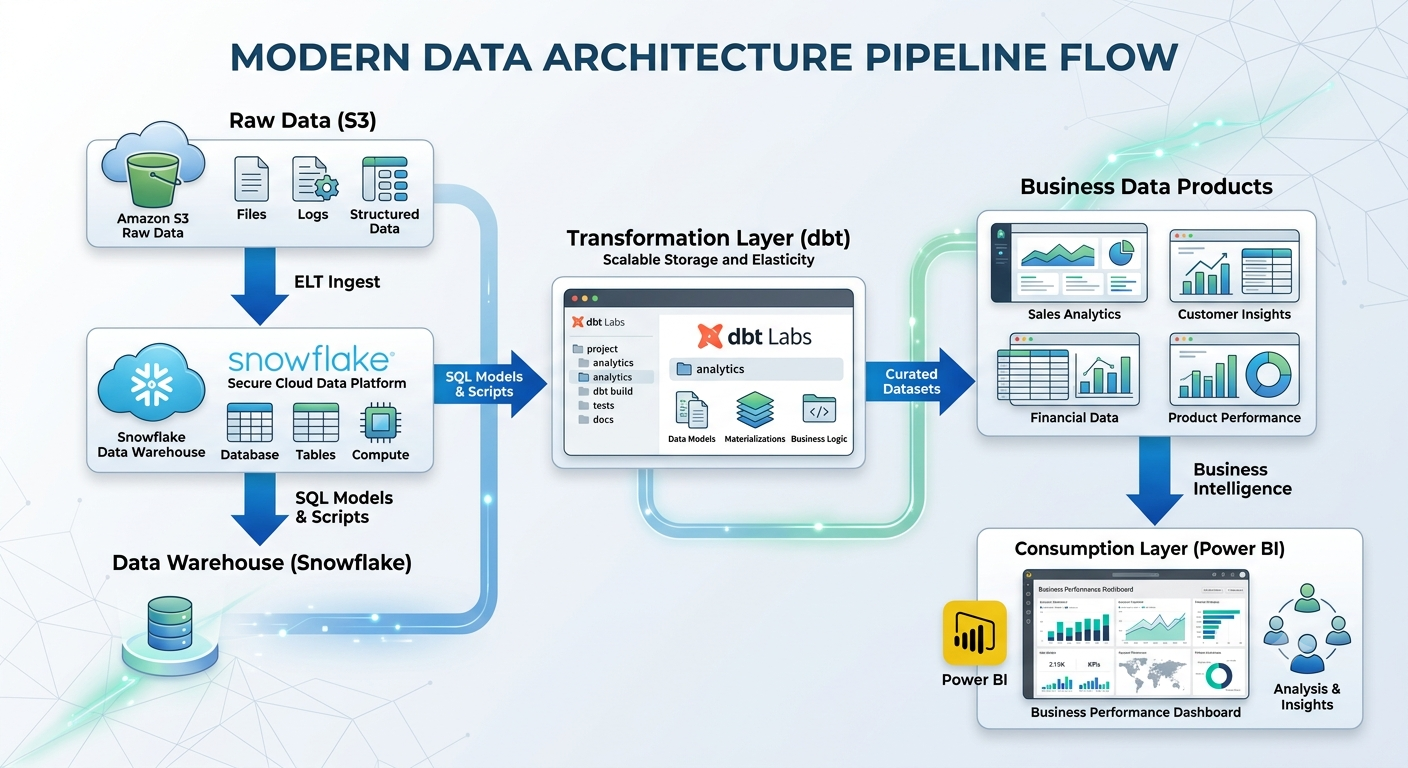
At first, this looks obvious. But the key insight is this:
Each layer exists for a different type of user, not just a different technical purpose.
Understanding Each Layer (The Key Insight)
Once I saw this, everything became clearer.
1. Raw Data (S3)
This layer is not meant for humans. It exists for:
- Storage
- Durability
- Replayability
At this stage, nothing is cleaned or modeled. It's just files.
2. Data Warehouse (Snowflake)
This is where structure begins to form. But importantly:
The warehouse is optimized for querying data, not understanding business logic.
This is where I first loaded Airbnb datasets. But I realized something: even though queries were faster, business questions were still complex. Because raw tables don't represent decisions. They represent events.
3. dbt Transformation Layer
This is where things started to change. Instead of writing one-off SQL queries, dbt forced me to think in layers:
- Staging models
- Dimensions
- Facts
At first, this felt like extra work. Why not just create final tables directly? But as the project grew, I noticed something: every repeated SQL pattern started moving into reusable models.
That's when I understood: dbt is not a tool for writing SQL. It's a tool for organizing logic.
4. Business Data Products
This is where the real shift happens. Instead of asking "What table do I need?", I started asking: "What business concept should exist as a reusable dataset?"
That led to:
- Host360 → one row per host
- Listing360 → one row per listing
- Neighborhood Summary → one row per neighborhood
These are no longer transformations. They are products.
5. Consumption Layer (Power BI)
Finally, dashboards are not the system. They are the output. And this was another mental shift:
Dashboards are not where logic lives. They are where logic is consumed.
The Key Realization That Changed Everything
Once I saw the full architecture, one thing became obvious: writing SQL without designing the system first is like building roads without a city plan. You can do it. But eventually:
- Routes become inconsistent
- Traffic (queries) becomes messy
- Maintenance becomes expensive
- And no one trusts the system
How This Changed My Airbnb Project
After defining the architecture, I stopped writing random transformations. Instead, every model had to answer:
- Where does this sit in the architecture?
- Who is the consumer of this layer?
- Is this logic reusable or duplicated?
- Does this belong in staging, intermediate, or marts?
This single change made the project more structured immediately.
The Revised Architecture (Airbnb Project)
After this realization, the project started to look like this:
S3 (Airbnb raw data)
        ↓
Snowflake (raw tables)
        ↓
dbt staging models
        ↓
dim_host
dim_listing
fact_reviews
fact_calendar
        ↓
intermediate models
        ↓
Host360
Listing360
        ↓
Neighborhood Summary
        ↓
Power BI Dashboards
But more importantly: each layer now had a purpose beyond "transformation".
Why This Step Matters More Than Any Tool
At this point, I hadn't written complex SQL yet. But I had already made the most important decision: I designed the system before implementing it.
That's the difference between:
- Someone who writes queries
- Someone who builds analytics systems
What Comes Next
Now that the architecture is defined, the next question becomes practical: How do we actually move raw Airbnb data from S3 into Snowflake in a structured, repeatable way?
That's where we'll go next. In the next article, we'll move from architecture to implementation and start building the ingestion layer inside Snowflake.